
A simple diagnostic framework for understanding why people say no — and for turning resistance into progress.
The Influence Equation
™
Overcoming Resistance and Changing Minds


Know the No
Most influence advice focuses on making a better case — clearer arguments, stronger facts, better framing. But persuasion often fails not because the argument is weak, but because resistance is strong. The Influence Equation reveals that understanding resistance is the hidden key to influence.
Resistance Is Information
Resistance isn’t just an obstacle to overcome — it’s a signal. It reveals how the other person sees the situation and what matters to them. When you treat resistance as information, conversations become opportunities to learn rather than battles to win.

Don't Guess — Diagnose
Virtually all real-world resistance fits one of these three lenses: Logic (it doesn’t make sense to them), Interests (it fails to meet what matters to them), or Trust (they don’t experience you as an ally). These three lenses let you diagnose the cause of the resistance.
Field Tested Framework
The framework has been developed and refined through years of teaching negotiation and influence at Harvard Law School’s Program on Negotiation and in professional programs in the United States, Europe, and Australia.
The Hard Science
of Soft Skills
A Framework You Can Use
Simple tools for diagnosing resistance and guiding real conversations forward
@@ Influence =/ Persuasion / Resistance
@@ When you understand their resistance — what they need, what they fear, and the values at stake — you make room for your persuasion to land.
@@ Logic =/ Logical (to them) / Illogical (to them)
@@ When ideas don’t make sense to them, even strong arguments fail to get through. Influence begins with translating your reasoning into their logic.
@@ Interests =/ Interests Met / Unmet Interests
@@ Even strong proposals fail when they miss what’s important to the other person. Learn their priorities.
@@ Trust =/ Ally / Adversary
@@ Trust isn’t about being likeable or having good intentions–it’s about whether they experience us as an ally or an adversary.
@@ / Don’t Pitch / Play Catch
@@ Their resistance can trigger us to persuade more, not listen, and that instinct prevents us from understanding the causes of their resistance.
@@ / “They Just / Don’t Get It”
@@ When people disagree, we assume they're missing something and explain our reasoning again because our logic feels objective––disagreement looks like their error. But persuasion works inside their logic not ours.
@@ / A "No" means / unmet interests
@@ When they say no, don’t argue—ask what about your proposal doesn’t work. Their answer points directly to the interests your proposal isn’t meeting.
@@ / Distrust Shuts / The Gate
@@ When people don’t trust your motives or competence, influence rarely gets traction. Before your ideas will be considered, people need to know you’re on their side.


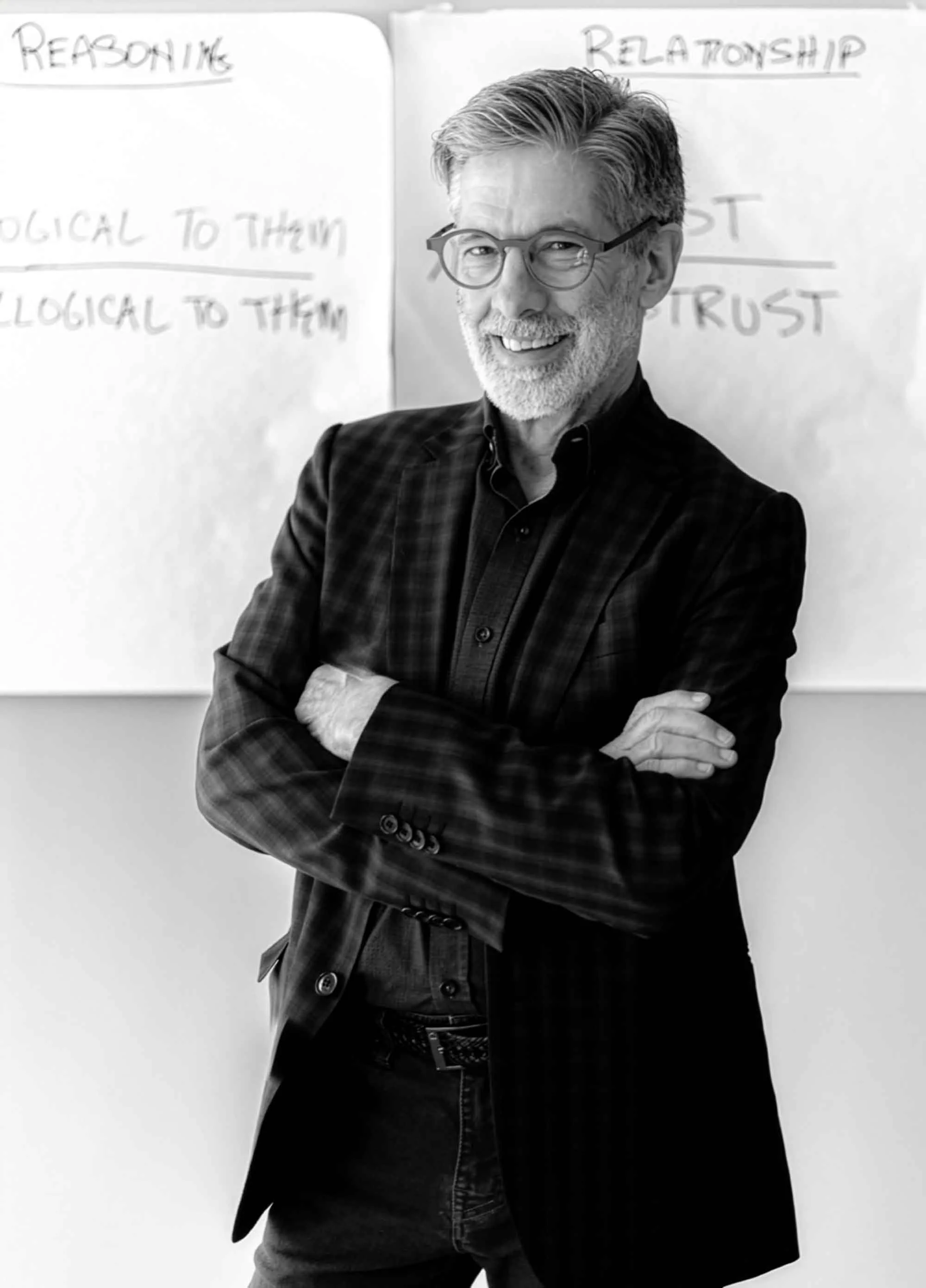
Stevenson teaches mediation and influence at Harvard Law School’s Program on Negotiation and works with leaders and organizations facing difficult conversations and complex change. Over more than thirty years, he has taught, consulted, and coached in corporate, governmental, and international settings.
As a single parent of six children—two teenagers and two young adults still living at home—Stevenson has daily (and sometimes hourly) opportunities to practice influence under real-world conditions. It has been a humbling education in what works, what backfires, and how quickly good intentions fall apart when resistance shows up.
Stevenson began his career in the theater as an actor, director, and teacher of actors. There he learned that theories alone, no matter how elegant, are often hard to apply when the moment arrives. Actors had to learn how to negotiate with their own thinking in order to behave naturally under pressure.

When he later began working in negotiation and conflict management, he recognized the same challenge: people often know the right advice but struggle to apply it when the stakes are real.
The Influence Equation grew out of his long-standing interest in how people turn good ideas into actions they can actually carry out when it matters.
Through his teaching and consulting work, Stevenson has worked with organizations ranging from government agencies and international institutions to global corporations.
The Influence Equation reflects patterns he has observed across boardrooms, classrooms, and families alike.

Photo by Michael L. Carlebach
Pursuation often fails not because the argument is weak but because the resistance is strong.
Professional Affiliations
Stevenson Carlebach teaches and collaborates with organizations focused on negotiation, communication, and conflict management — work centered on how people navigate differences and make decisions together — including:
Program on Negotiation at Harvard Law School
Triad Consulting
Vantage Partners
Insight Partners
Habitus
Common Outlook Consulting
Selected Clients
Stevenson Carlebach has worked with leaders and organizations across the private and public sectors, including:
The White House
U.S. Department of Defense
World Bank
United Nations
Amazon
Microsoft
Pfizer
Vertex
Starbucks
American Express
Merrill Lynch Capital One
IBM

About Eque
Eque LLC is Stevenson Carlebach’s training and consulting practice, focused on influence, difficult conversations, negotiation, and mediation.
Drawing on the tradition of the Harvard Negotiation Project, Eque’s work combines practical experience with the research behind effective communication and decision-making — what Stevenson has sometimes described as the hard science behind soft skills.
Over more than three decades, this work has been tested and refined across both the public and private sectors in the United States and internationally.
Stevenson has worked with organizations ranging from government agencies and international institutions to global corporations, helping professionals navigate complex decisions and difficult conversations where influence matters.
The Influence Equation framework grew directly out of this work. Workshops, coaching engagements, and mediation settings have provided a laboratory for developing and refining practical approaches that help people remain thoughtful and effective when conversations become difficult.